Ask tax gurus Mihir Tanna, Samkit Maniar, Vivek Lala, Anil Rego, T S Khurana and Mahesh Padmanabhan your Budget-related tax questions
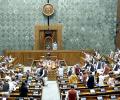
India's opposition parties have sharply criticized the Union Budget, calling it inadequate to address the country's economic woes and accusing the BJP-led government of using it to woo voters in Bihar and Delhi ahead of upcoming elections. Leaders from the Congress, TMC, DMK, SP, and CPI(M) voiced their disapproval, highlighting concerns over inflation, unemployment, and the lack of substantial measures to support the agricultural sector and the poor. They also criticized the tax cuts for the middle class as insufficient and coming too late after years of high taxes and rising prices.

The Brihanmumbai Municipal Corporation (BMC) has decided to impose property tax on commercial establishments operating in slum areas and is also considering the levy of a Solid Waste Management (SWM) user charge in the future. The civic body is expecting to collect a total of Rs 5,200 crore in property tax during the next financial year. The BMC intends to levy an SWM charge on Mumbaikars in a phased manner though it would not be levied in FY 2025-26.

'There's a misconception that all Rs 1 lakh crore will be spent immediately, leading to higher consumption of FMCG goods, travel, and vehicle purchases.' 'While some of this money will go toward consumption, not all of it will.' 'The impact depends on where people deploy their savings.'

Lok Sabha Speaker Om Birla on Friday constituted a 31-member Select Committee of the lower house to examine the Income Tax Bill. To be headed by Bharatiya Janata Party's Baijayant Panda, the panel is mandated to submit its report by the first day of the next session.

The time is ideal for a 'Dream Budget' akin to the 1991 reforms that sparked high growth and unlocked significant gains in productivity, points out Rajeswari Sengupta.

'It must become faceless, just as the entire direct tax assessment system has already become fully online, without any human intervention in the normal course,' recommends A K Bhattacharya.

"The new structure will substantially reduce taxes on the middle class and leave more money in their hands, boosting household consumption, savings and investment," Sitharaman said presenting what was dubbed as 'reformist' budget for the next fiscal in Lok Sabha.
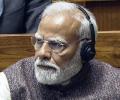
Prime Minister Narendra Modi has lauded the Union Budget as a "people's budget" that fulfills the dreams of every Indian and said that it is a "force-multiplier" that will boost consumption, investment and growth. He highlighted a host of measures for different sectors, including welfare initiatives for gig workers, tax relief for the middle class, and support for the manufacturing sector.

The finance minister, in her Budget speech, should focus more on what she is directly responsible for, rather than on programmes where her role is largely supportive, notes Nitin Desai.

As per established tradition, the finance minister met the President at the Rashtrapati Bhavan before heading to Parliament.

With lower GST rates taking effect, fast-moving consumer goods players face challenges in setting reduced prices for their products in round figures, but expect the magical price points to be restored within two months.
Starting with the proposed retrospective amendment to Section 9 of the Income Tax Act, seen as a move to get over the adverse Supreme Court verdict on Vodafone, the controversy spilled over to taxation of foreign portfolio investments and taxation of foreign assets of Indians.

A string of welfare schemes and promises tests the state's budget, which is already heavily dependent on central support and spends little as capital outlay.

Real estate developers are hoping that the slew of tax concessions announced in Union Budget 2025, set to take effect this financial year, will spur demand for affordable and mid-segment housing, even as the broader housing market shows signs of fatigue.

His victory means that his party will have to learn from him, because after the rise of Donald Trump, the Democrats have been in disarray. They have had no real answer to the Trump phenomenon and Zohran, with his emphatic and clear policies aimed at working class Americans offers them a national path for a return, asserts Aakar Patel.

'Some buyers get carried away by festival offers and purchase higher variants or larger vehicles than they truly need, which impacts running cost and long-term affordability.'

It will be the second Budget of the Modi 3.0 government and eighth straight Budget for Nirmala Sitharaman, rare in Indian polity.

Billionaire Mukesh Ambani on Thursday termed the second-generation GST reforms as a big booster to consumption-driven growth while his firm promised to pass on the benefit of the cut in tax rates to consumers.

Individuals earning up to Rs 12 lakh annually will not have to pay any income tax under the new tax regime as Finance Minister Nirmala Sitharaman on Saturday gave relief to middle class by raising exemption limit and rejigging slabs. For salaried employees, this nil tax limit will be Rs 12.75 lakh per annum, after taking into account a standard deduction of Rs 75,000.

New lower GST rates kicked in from Monday, resulting in a slashing of prices of as many as 375 items ranging from toothpaste and shampoo to cars and television sets, a move seen as an attempt to boost consumption to cushion an economy facing tariff headwinds. Tax rates of 5, 12, 18, and 28 per cent have been clubbed into two rates of 5 per cent and 18 per cent, resulting in a reduced price of 99 per cent of daily use items.

Implications for capital gains, wealth taxes, and investment strategies require careful consideration, notes Anil Rego, founder and CEO, RightHorizons.
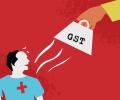
Reduction of GST on health insurance premium from 18% to 0% looks like a straight 18% reduction in what consumers pay. The truth, however, is...

'Do exhaustive research and then select the one that best fits your budget and requirements.'

The Budget 2025-26 meets the expectations of fiscal consolidation, maintaining capital expenditure, and boosting consumption through tax cuts.

Foreign portfolio investors sold stocks worth Rs 1.42 trillion in 2025, with their sales hitting Rs 12,257 crore in the first four trading days of September.
After three straight quarters of decline, India's housing market is pinning hopes on the ongoing festival season to revive sales momentum. While 2025 may still end with sales volumes below 2024 levels, developers believe the seasonally strong October-December quarter could narrow the gap, aided by stable interest rates, festive incentives, and resilient demand in the premium segment.
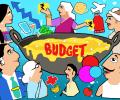
Following the lacklustre growth numbers in the second quarter (Q2FY25), economists believe the upcoming Union Budget for 2025-26 should focus on reforms that will stimulate consumption, manufacturing and spur employment. India's growth unexpectedly slowed to 5.4 per cent in the second quarter, due to low capital formation, weak consumption, besides adverse weather impact.

If he cannot do it this term by using his bureaucracy and experts from different fields, it will be a tragedy, asserts Ramesh Menon.

State Bank of India chairman Dinesh Kumar Khara has pitched for tax relief on interest income, saying it would help banks to garner savings that could be used for funding long-term infra projects. Currently, banks are required to deduct tax when interest income from deposits held in all the bank branches put together is more than Rs 40,000 in a year. With regard to savings accounts, interest earned up to Rs 10,000 is exempt from tax.

GST 2.0 may cushion consumers against US tariffs, but like the 2019 corporate tax cut, it risks being another tactical fix rather than a structural growth strategy, expects Debashis Basu.
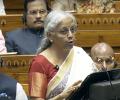
Here are some facts related to the Budget presentation in independent India.
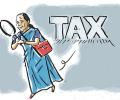
Three industry bodies suggested changes in India's tax regime in their pre-Budget discussions with Revenue Secretary Sanjay Malhotra in New Delhi on Tuesday. The bodies - Confederation of Indian Industry (CII), PHD Chamber of Commerce and Industry (PHDCCI), and Federation of Indian Chambers of Commerce & Industry (FICCI) - held separate meetings with Malhotra during the day and put across their suggestions for the upcoming Budget.

Finance Minister Nirmala Sitharaman on Thursday asked India Inc to take advantage of the policies and reforms undertaken by the government and no longer hesitate to invest more and expand capacities. Sitharaman also asked the industry to partner with the government for skilling the youth and also to engage with the government throughout the year, and not just before the Budget.

'That is going to have an impact on literally every one, whether you buy a toothpaste, a safety pin, a car, shoes or medicines or you go to a diagnostic centre.'

'Tax rate and stock markets are entirely two different things.'
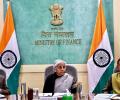
The Budget assumes significance as it comes on the back of lower-than-expected growth numbers during the second quarter and geopolitical uncertainty.
The government's indirect tax collection is expected to increase by 8.3 pc in the financial year 2025-26 (FY26), according to a report by ICICI Bank. The report also noted that this growth is higher than the 7.1 per cent increase seen in FY25 and is mainly driven by rise in GST revenue from strong urban consumption. It said "The increase is driven by higher goods and services tax collections which in-turn is explained by boost to urban consumption".

'In case a particular industry has not passed on the benefits and if we receive complaints, we will take up the matter with the industry body concerned.'

'The increase in the limit for TDS on interest to Rs 1 lakh will ensure greater cash flow in the hands of senior citizens.'
 © 2026 Rediff.com - Advertise with us - Disclaimer - Privacy Policy - Sitemap - Feedback - About us - Terms of use - Grievances